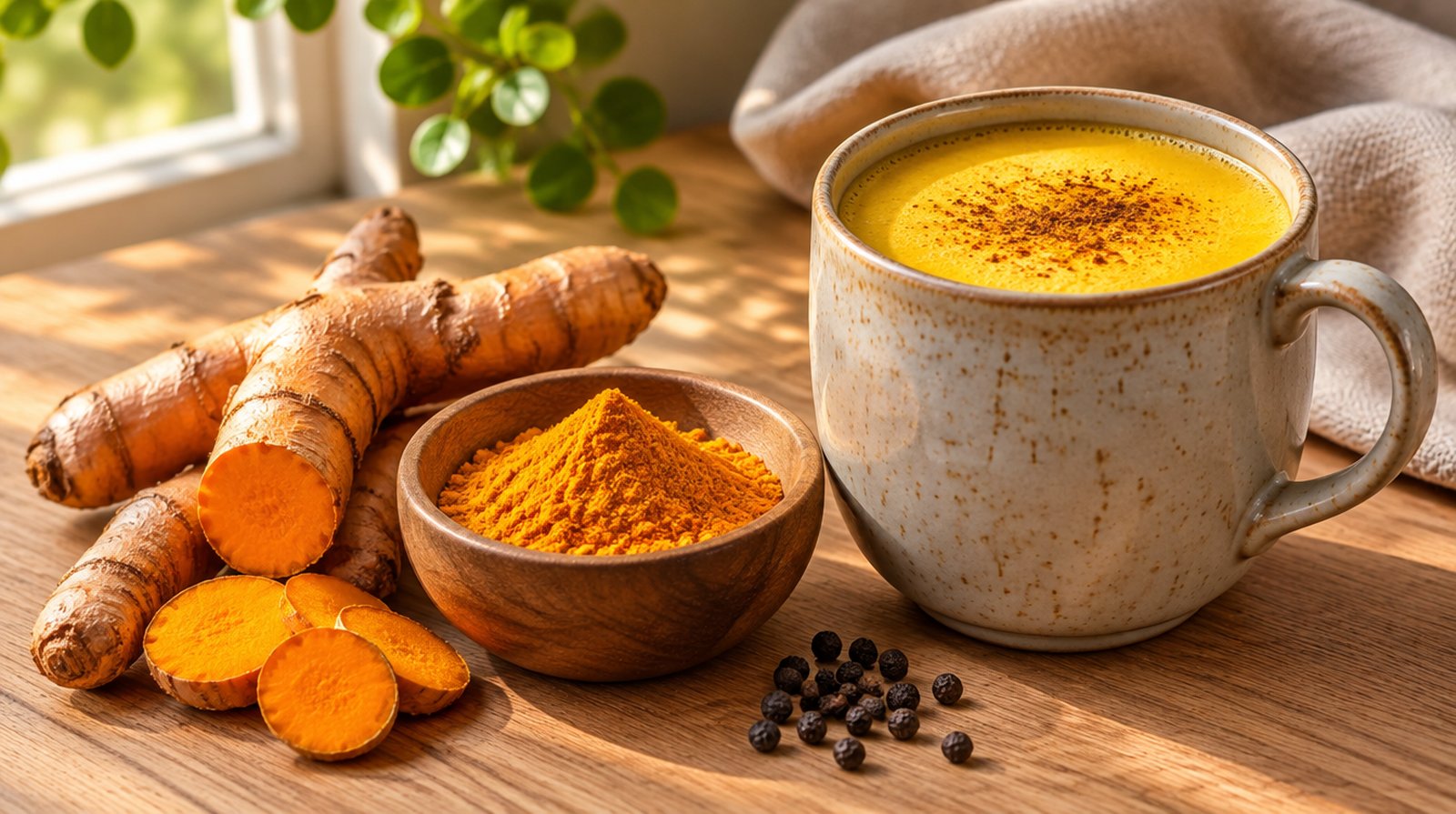
Turmeric may help with perimenopause, especially achy joints and hot flashes. In a 2026 placebo-controlled trial, women taking 1,000 mg a day of curcuminoids (the active compounds in turmeric) had about seven fewer hot flashes a week than women on placebo, and other trials link curcumin to less fatigue and better joint comfort in midlife women. Here is what the research shows, what women say, and how to use it safely.

Disclosure: My husband, Brandon, does freelance marketing work for Immunotec, the company that makes She+. I got She+ free as an early tester.
- Turmeric’s main active compounds, curcuminoids, have antioxidant and anti-inflammatory effects that researchers are now testing for menopause symptoms.
- A 2026 randomized, placebo-controlled pilot trial found 1,000 mg a day of curcuminoids cut hot flashes by about 7 more episodes a week than placebo over 12 weeks.
- In a 2025 trial of 74 women, 500 mg of curcumin twice a day for 8 weeks improved fatigue and musculoskeletal health compared with placebo.
- Many women on menopause forums say turmeric with black pepper eased their aching joints and hips.
- Talk to your doctor first if you take blood thinners, have liver or gallbladder problems, or are pregnant, and stop if you notice signs of liver trouble.
Why I started reading about turmeric
My perimenopause symptoms showed up about a year ago. First it was low energy, then my sleep started slipping, then the hot flashes arrived, along with nights where I woke up hot and sweaty. If you are trying to figure out whether what you are feeling is perimenopause, my complete list of perimenopause symptoms is a good place to start.
Like a lot of women, I went looking for natural options before anything else. Magnesium was my first try, and it did not help me. What finally made a difference was She+ by Immunotec, which I have been taking for a couple of months (I wrote about it in detail in my She+ review). But turmeric keeps coming up in my inbox and in the menopause groups I read, so I dug into the research to see what it can actually do during perimenopause.
What is turmeric, and why would it help in perimenopause?
Turmeric is the golden root used in curries and golden milk. Its best-studied compounds are called curcuminoids, and curcumin is the main one. Researchers are interested in curcuminoids for menopause because of their antioxidant and anti-inflammatory properties, and because many women want options that are not hormone therapy.
That anti-inflammatory angle matters in perimenopause. As estrogen shifts, a lot of us notice stiff joints, general achiness, more fatigue, and changes in heart and blood vessel health. Turmeric has been studied for all of those.
What the research shows
Hot flashes
2026 placebo-controlled trialThe most exciting study is brand new. In a 12-week randomized, double-blind trial published in BMC Complementary Medicine and Therapies in 2026, 40 women aged 41 to 65 took either 1,000 mg a day of curcuminoids or a placebo. By week 12, the curcuminoid group had about 7.35 fewer hot flashes a week than the placebo group, and the difference already showed up at week 6. Women also reported better hot-flash-related quality of life at week 6. Everyone finished the study, with no serious side effects. The researchers call it a pilot trial and want larger studies next, but it is a really encouraging start. The women in this study were postmenopausal, so it is a helpful signal for those of us in the perimenopause years too.
Fatigue and achy joints
2025 randomized trialA 2025 double-blind trial in BMJ Open gave 74 postmenopausal women aged 40 to 60 either 500 mg of curcumin twice a day or a placebo for 8 weeks. The curcumin group had significantly better musculoskeletal health scores and significantly less fatigue than the placebo group. For anyone whose perimenopause shows up as stiff mornings and dragging afternoons, that is worth knowing.
Knee and joint pain
NIH overviewThe National Center for Complementary and Integrative Health says several meta-analyses have looked at oral turmeric or curcumin for knee osteoarthritis pain, stiffness, strength and mobility, and that the initial evidence is positive. GoodRx’s physician-reviewed guide to supplements for menopause joint pain lists curcumin first and notes studies used 500 mg to 2,000 mg a day.
Mood and stress
2026 meta-analysisA 2026 dose-response meta-analysis pooled 26 randomized trials with 1,491 adults and found curcumin significantly reduced symptoms of depression, anxiety and stress compared with placebo. Improvements were slightly greater in women. These were general adult studies, not menopause-specific, but mood swings and anxiety are such a big part of perimenopause that I wanted to include it.
Heart and blood vessels
2024 systematic reviewHeart risk climbs for women around menopause. A 2024 systematic review in Biomedicines concluded that curcumin has beneficial effects on blood vessel function during menopause, including endothelial function and arterial flexibility. A 2025 review of 12 randomized trials also found that longer-term use of well-absorbed curcumin improved fasting glucose, insulin resistance and lipid levels in postmenopausal women. You can read more about this in my post on menopause and heart health.
The studies at a glance
| Study | Who | Dose | What improved |
|---|---|---|---|
| BMC Complement Med Ther, 2026 | 40 women, 41 to 65 | 1,000 mg curcuminoids daily, 12 weeks | About 7 fewer hot flashes a week vs placebo |
| BMJ Open, 2025 | 74 postmenopausal women | 500 mg curcumin twice daily, 8 weeks | Fatigue and musculoskeletal health |
| Food Nutr Res, 2026 (meta-analysis) | 26 trials, 1,491 adults | Varied; more benefit above 1.5 g/day | Depression, anxiety and stress scores |
| Biomedicines, 2024 (review) | Menopausal women and models | Varied | Blood vessel function |
What women say about turmeric
I always want to hear from real women alongside the studies. Here is what I found, paraphrased from public forums:
- On Mumsnet, one woman said turmeric tablets with black pepper and vitamin D got rid of her hip pain, and that the pain comes back when she forgets to take them (Mumsnet).
- In another Mumsnet thread about aching joints in menopause, one woman said her aches had all but vanished after two weeks on a turmeric and black pepper supplement, and another estimated turmeric cut her joint pain by about half (Mumsnet). A third paired turmeric with daily weight-bearing exercise.
- A woman on a natural remedies thread said turmeric with black pepper, along with black cohosh tea, helped her through menopause (Mumsnet).
- On the Menopause Matters forum, women taking turmeric for general aches said it was starting to help or helped “so much,” and one who had used a curcumin capsule for 18 months reminded others that larger doses may thin the blood (Menopause Matters).
Not everyone notices a difference, and plenty of women also love turmeric simply as food. A recurring tip is to pair it with black pepper and a meal that has a little fat, since that helps your body absorb it.
How to use turmeric in perimenopause
- Cook with it. Turmeric in curries, soups, eggs, roasted vegetables and golden milk is an easy, low-key way to add it. It fits right into a perimenopause-friendly diet.
- Know the study doses. The hot flash trial used 1,000 mg of curcuminoids a day. The fatigue and joint trial used 500 mg twice a day. Joint pain studies range from 500 mg to 2,000 mg a day.
- Help absorption. Curcumin on its own is not absorbed well. NCCIH notes that piperine from black pepper is one way to improve that, and GoodRx suggests taking it with a meal that contains some fat.
- Give it time. In the hot flash trial, the benefit showed up by week 6 and held at week 12.
- Pair it with other habits. Turmeric works alongside the basics, like the ones in my guide to reducing hot flashes naturally, and other herbal remedies for hot flashes.
Talk to your doctor first
- Blood thinners: Memorial Sloan Kettering notes that turmeric may increase bleeding risk if you take warfarin or other blood thinners.
- Liver health: NCCIH says turmeric is likely safe in recommended amounts for 2 to 3 months, but liver damage has been reported in some people using high-absorption formulas. The US Pharmacopeia calls these cases very rare and recommends checking with your provider if you have a history of liver problems. Stop and call your doctor if you notice belly pain, dark urine, or yellowing of your skin or eyes.
- Pregnancy: NCCIH says turmeric supplements may be unsafe during pregnancy. If there is any chance you could be pregnant, ask first.
- Gallstones, kidney stones, diabetes or bleeding problems: GoodRx lists these as reasons curcumin may not be right for you.
- Cancer treatment or breast or uterine cancer history: MSK notes turmeric can interact with some chemotherapy drugs, so check with your oncology team.
- Stomach upset: Mild side effects can include nausea, reflux, diarrhea or constipation.
My take
Turmeric is one of the more promising natural options I have looked into for perimenopause. The new hot flash trial is encouraging, the fatigue and joint research lines up with what so many women describe, and it is easy to add to food. If achy joints are a big part of your perimenopause, it is worth a conversation with your doctor.
I have not taken turmeric on its own. For my hot flashes, night sweats and sleep, the thing that has worked for me is She+. Since starting it, my Oura ring went from showing me waking about every 10 minutes to sleep scores in the 80s and 90s. I have more energy, and my hot flashes have calmed down. It includes black cohosh, red clover and ginger, which I cover in my honest She+ by Immunotec review. It is not hormone replacement therapy (HRT), and it comes in a jelly stick instead of another pill, which I love. The apple blueberry flavor feels like a treat. It runs about $44 a box on subscription ($59 retail).
FAQ
Does turmeric help with hot flashes?
It may. In a 2026 randomized, placebo-controlled trial, women taking 1,000 mg of curcuminoids a day had about 7 fewer hot flashes a week than women on placebo after 12 weeks.
Is turmeric good for perimenopause joint pain?
Many women say so, and research backs it up. A 2025 trial found curcumin improved musculoskeletal health and fatigue in midlife women, and NIH’s NCCIH calls the early evidence for knee pain positive.
How much turmeric should I take for perimenopause?
Studies have used 500 mg to 2,000 mg of curcumin or curcuminoids a day. Ask your doctor what makes sense for you, especially if you take other medicines.
Can I take turmeric with HRT?
Women on the Menopause Matters forum report taking both. Turmeric can interact with some medicines, including blood thinners, so check with your provider first.
Is turmeric in food enough?
Cooking with turmeric is a great habit, but the studies used concentrated curcumin supplements at much higher amounts than a typical meal provides.
How long does turmeric take to work?
In the hot flash trial, women saw a difference by week 6, and in the fatigue and joint trial, by week 8.
Sources
- Buntoonprayuk J, et al. Curcuminoid supplementation for vasomotor symptoms in postmenopausal women: a pilot, randomized, double-blind, placebo-controlled trial. BMC Complement Med Ther. 2026. PMID 41877056.
- Shabani F, et al. Effect of curcumin on fatigue and musculoskeletal health in postmenopausal women: a double-blind randomised controlled trial. BMJ Open. 2025. PMID 40976665.
- Effects of curcumin on depression, anxiety, and stress symptoms in adults: a systematic review and dose-response meta-analysis. Food Nutr Res. 2026. PMID 42859601.
- Mad Azli AA, et al. The role of curcumin in modulating vascular function and structure during menopause: a systematic review. Biomedicines. 2024. PMID 39457594.
- Akyakar B, et al. The effect of curcumin on postmenopausal symptoms: a systematic review based on randomized controlled trials. Int J Mol Sci. 2025. PMID 40943181.
- Akhtar N, et al. Rarely reported cases of hepatotoxicity associated with turmeric- and curcuminoid-containing dietary supplements: a review by USP. Pharm Biol. 2026. PMID 42364655.
- National Center for Complementary and Integrative Health. Turmeric.
- Memorial Sloan Kettering Cancer Center. Turmeric.
- GoodRx Health. The best supplements for menopause joint pain. 2025.
This article reflects one person’s experience and is for general information only. It is not medical advice. Talk with your healthcare provider before starting any supplement.
Leave a Reply